VAOHP featured in HASTAC!

Click title to be re-directed to:

Spring Spotlight 1: The Deconstruction/Reconstruction of the Community and Institution Collaborative Model

From the HASTAC {Humanities, Art, Science, and Technology Advanced Collaboratory} website:

“These DH projects define how existing collecting methods have been tested, challenged and reconstructed to achieve their successful outcomes. Each project takes the basic idea of creating an online resource on knowledge that historically hasn’t been available to interested audiences.

The community collaborative projects are based on these general ideas.

  • A model based on acquisition, preservation and distribution of an existing cultural history parallel to, but not included in the American narrative.
  • An anecdotal history through interviews and a history based on material acquisitions in danger of being lost without this effort to acquire and preserve it.
  • A history presented in visualizations that organize large amounts of data into a manageable visitor experience. Content that has a goal of informing a range of visitors, engaging a community eager for this history and encouraging future scholarship.

Spotlight organizer: Linda Garcia Merchant, Technical Director, Chicana Por Mi Raza Oral History Project
Email: linda@vocesprimeras.com


Interactive History: Generation of Stories

Last summer a group of Vietnamese American Oral History Project interns set out to interview residents of The Grove Senior Apartments in Garden Grove, California where well over half of the population are Vietnamese Americans.  In order to find narrators, they first had to be visible and credible. The opportunity presented itself for VAOHP to partner with a nonprofit organization called EngAGE. Here’s a short description of this organization:

“EngAGE is a nonprofit that takes a whole-person approach to creative and healthy aging by providing arts, wellness, lifelong learning, community building and intergenerational programs to thousands of seniors living in affordable senior apartment communities in Southern California.”

EngAGE has had a presence in The Grove for some time, organizing events such as Senior Olympics and a talk story program that trained seniors to write about and share their life experiences. When I first heard about EngAGE, I knew that a partnership with them would be mutually beneficial. A senior resident, Mr. Anthony LeDuc, reached out to me and invited me to The Grove in May 2012. I met him and EngAGE representative, Nancy Goodhart.

A few weeks later the opportunity came by way of my students’ decision to apply for UC Irvine’s Undergraduate Research Opportunities Program (UROP) to conduct oral history interviews over the summer. The Grove already had a built-in population of people we could interview. The research team initially consisted of Howard Diep, Michelle Pham, Tram Vo, Viola Van, and Stephanie Wong. Over the course of the summer, we lost Stephanie to a grad program but we acquired two more interns: Chris Truong and An-Nhien Doan (a Goldenwest College student). We came up with the title for this project in The Grove—Interactive History: Vietnamese American Elders’ Stories. The name suggests that the making of history is an interactive process involving the story-teller and mediated by the listener across different generations. The Interactive History project forges a space in order to capture the stories of some seniors in The Grove, generating stories across generations.

The Opening Social Mixer on August 7, 2012 at The Grove Senior Apartments

Our Opening Social Mixer on August 7, 2012 was a success with the attendance of all the above named students, representatives of EngAGE and about 20 seniors living in The Grove. During this social mixer, we presented our objectives and stories of other Vietnamese Americans who have participated. This initial mixer helped us to recruit volunteer narrators.

Over the course of the summer and early fall, the VAOHP interns headed by Michelle Pham conducted interviews with the seniors. Their efforts culminated in a Closing Social Mixer on November 27, 2012 where the seniors who participated were presented with thank you gifts and EngAGE representatives Nancy Goodhart, Robin Hart, and Dr. Maureen Kellen-Taylor came to celebrate with the students and residents.

From left: 1. gifts for participants 2. narrators, EngAGE representatives Nancy Goodhart and Melly Morse, and VAOHP representatives Thuy Vo Dang, Michelle Pham, and Howard Diep 3. Michelle Pham presents narrators’ stories.

During the bilingual Enlish and Vietnamese presentation, one of the seniors Mr. Le Huu Khoan made a moving speech about his participation in the project. Mr. Le Huu Khoan was interviewed by Michelle Pham and he imparted his appreciation and his thoughtful feedback on how to improve future efforts to interview seniors at The Grove or other apartment communities similar to it. Below is an excerpt of his translated speech:

“Truthfully, during that conversation—yes, indeed a conversation—with Michelle over more than 5 hours, I recollected ‘My Life’ in full detail, including the joy and the sorrows, moments of happiness and those of pain, “lên voi và xuống chó” [an expression that means riding high such as on the back of an elephant and sinking low as to the level of dogs], successes and failures,  peace and danger,  good health and illness, luck and misfortune…and so on. One could say that: I was born in wartime, grew up and matured during wartime, participated in the “game” of war and ended up a prisoner of that war. One could say that what I shared can be a mirror reflecting many of the lives of seniors present here, the Vietnamese Americans in their 70s and 80s and up.”

Mr. Le Huu Khoan and his peers in The Grove have generously shared with the interns and with the world a snippet of their lives and we hope that this will inspire others to do the same.

Seniors mix and mingle at the Closing Social Mixer on November 27, 2012

~Thuy Vo Dang

VAOHP Community Reception: website launch and celebration

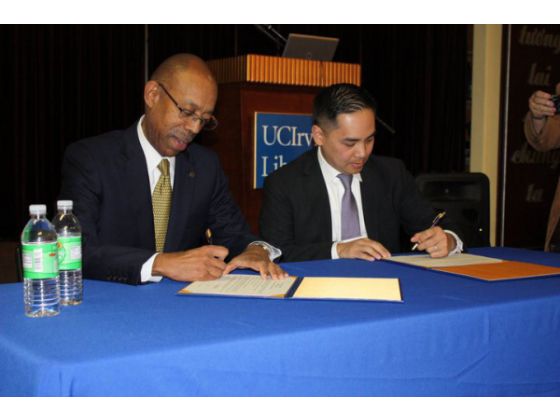
Last week VAOHP held a community reception at Van Lang Community Hall to celebrate the formal launch of their official website.  Along with the collective efforts of the Vietnamese American Heritage Foundation (VAHF) based in Texas, VAOHP has made UC Irvine the new home of hundreds of Vietnamese life stories. Dr. Thuy Vo Dang along with Dr. Linda Trinh Vo served as the event’s masters of ceremonies. Along with a league of volunteers and research interns, the event was up and running in a matter of hours. Upon arrival guests were greeted at the entrance hall along with a nametag, those that participated as narrators had blue ribbons attached.  Once inside guests indulged in traditional Vietnamese finger foods and the moving art work of Trinh Thuy Mai. With volunteers replenishing the food table there wasn’t an empty belly nor a clean hand in sight. Speakers from UC Irvine and VAHF spoke of the importance of continuing such and endeavor.  As an added bonus the VAHF awarded Dr. Linda Trinh Vo and Dr. Thuy Vo Dang with plaques of accomplishment for all they have done for the Vietnamese community.

From left: VAOHP interns, the audience, Asian American Studies Department chair, Dr. Jim Lee, speaks, Wells Fargo representatives present VAOHP a giant check.

From my humble perspective, the milestones that VAOHP has made in a year were simply mind boggling. When I became a part of the project only a few months ago I was told that the goal of this project was to bridge the gap between academia and community. The overwhelming outpour of support made me feel that my efforts and the efforts of those around me were being recognized by the community. The highlight of the night came from an extremely generous grant from the Wells Fargo foundation.  Our little “grass roots” project has blossomed into this, might I say, movement.  I can already imagine years down the line more narrators, volunteers, and interns will be added on to the growing project and hundreds of stories might become thousands.   The idea of leaving a piece of ourselves and our experiences for our children and future generations is something that resonates within our community.  All too often during my interviews I heard how parents and grandparents want to tell their stories to their children but have trouble doing so for whatever reason, whether it’s a language barrier or the even the wrong time.  The purpose of having this public unveiling was to help the community recognize that we are a possible resource to overcome these obstacles.  With people becoming more reliant on technology for information access, the online repository is perfect way to eloquently illustrate the fruits of our labor.

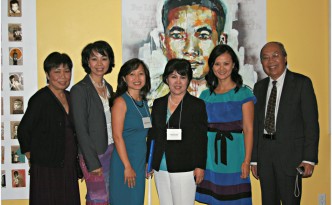
Features at the community reception, from left: Denise Cao, Giana Nguyen, Trinh Mai

To view the oral histories launched through the UC Irvine Libraries’ Southeast Asian Archive, please visit: vaohp.lib.uci.edu.


Representatives of the Vietnamese American Heritage Foundation and the Vietnamese American Oral History Project, from left: Long Nguyen, Dung Vu Hoang, Linda Vo, Nancy Bui, Thuy Vo Dang, Thieu Dang.

~Michelle Le Pham

~photos by Christopher Truong

Come and join the VAOHP at the Little Saigon Community Reception!

Come and join us as we have some exciting news in tow!

We are pleased to announce that we will formally launch the Vietnamese American Oral History Project (VAOHP) at UC Irvine’s website whilst celebrating the tremendous efforts of all the narrators, students, community supporters, and volunteers at a Community Reception in Little Saigon!

Along with entertainment and refreshments, the evening will consist of distinguished guest speakers, spotlight on the presentation of the website – which will include multi-media stations for guests to browse the website! Trinh Mai will join us as the feature artist!

Come and join us on Wednesday, October 24, 2012 from 5:30-8:30pm in the Van Lang Community Hall in the city of Westminister on 14861 Moran Street!

The community reception is free and open to whomever would like to learn more about the project and see what the VAOHP is all about!

If you have any questions, please do not hesitate to contact our advisor, Dr. Thuy Vo Dang! And don’t forget to check out our Facebook page for other news about the VAOHP!

We would also like to give a huge thanks to our Co-sponsors and Co-organizers!

We hope to see you all there!

Come join us for an “Interactive History Social Mixer!”

This Tuesday, August 7, 2012, the VAOHP will partner up with the non-profit, EngAGE, and host an “Interactive History Social Mixer” at the Grove Senior Apartments in Garden Grove, CA! Come and learn about our project and meet our research interns from UC Irvine whom are running the summer program at the Grove!

Co-sponsored by: 

*The event is free and open to all, so please come and join us! Refreshments will be provided!

An oral history “triangle”

This past week, I was given the opportunity to transcribe two oral histories conducted by the Vietnamese American Heritage Foundation. Although I have transcribed before, this particular task was rewarding because I was able to examine role-switching, various styles and methods in oral histories, and an oral history “triangle” so to speak.

At first I watched a video of Roger Le’s interview, conducted by Pham Quang Tuan. Previously I had already watched a video of Tiffany Le’s interview conducted by Roger, so it was a great surprise to see him in the narrator seat.  Since the video focused on Roger with Tuan’s voice in the background asking questions, I was intrigued by his calmness and quick response to questions. He was incredibly detailed, put a lot of thought into sharing stories, and had a lot to say.

Pham Quang Tuan interviews narrator, Roger Le

Pham Quang Tuan interviews narrator, Roger Le

At this point, I felt like a middle man between Roger Le, Pham Quang Tuan, and Tiffany Le. What I mean by this is that I was involved in an oral history “triangle.” I watched Roger Le interview Tiffany, I was watching Roger being interview by Tuan, and I was about to see a video of Pham being interviewed by Roger. Little did I know that it was essential to have skill, patience, and have mastered “role-switching” in order to be successful in oral histories.

Roger Le interviews narrator, Tiffany Le

Roger Le interviews narrator, Tiffany Le

So, how do you prepare to be an interviewer? How do you prepare to be a narrator? When watching Tuan’s interview conducted by Roger, he states that he wishes there was more time to train for the position, but that “it hasn’t been a challenge for me [him] so far” because he’s self-motivated. Similarly, Roger joined the VAHF as a technical director who worked on the website, and ended up being an interviewer as well. Roger and Tuan utilize different techniques in interviewing, which have been successful through many interviews. Yet, there is no “right” way to interview. From my point of view, to master the role of an interviewer, one must be a narrator first, to be in the hot-seat. From there on, practice is what makes perfect.

As a technical consultant, Roger came across interviewing this way:

“ I didn’t expect to interview as much, but it’s been a really eye-opening experience. I’m glad that I got the opportunity to do so, because when else can I travel across the United States interviewing some very prominent Vietnamese people.”

Overall, there is a diverse list of things that can be learned about oral histories. From watching this oral history “triangle” evolve and play both the narrator and interviewer roles, I was able to see how flexibility and determination make one successful in this field. Although Tuan and Roger both had little training in their roles, the influence and success they’ve had is more than extensive. They both have practiced and mastered their roles as interviewers, and have experienced being in the hot-seat themselves.

Roger Le interviews narrator, Pham Quang Tuan

Roger Le interviews narrator, Pham Quang Tuan

Before watching these videos, I experienced interviewing my dad myself, and watching Tiffany Le’s interview conducted by Roger. Yet after these interviews, I felt like I was in a position of role-switching. I felt like I knew both Roger and Tuan; after hearing their stories, being an outsider looking in, and pretending to be the narrator myself, I learned that oral histories is not an easy, but daunting task that can be greatly rewarding. A mixture of motivation, practice, and skill can make one very successful in oral histories, and I believe that anyone can bring eye-opening  style and technique to the table!


By Stephanie Wong

From Vietnam to Refugee Camp and America

When I first signed up for this project, I just wanted to be “behind the scenes.”  However, I had a chance to conduct my first interview with Mr. La Quoc Tam, and I found that I like it a lot.  We conducted this interview in a conference room of the Vien Dong Daily News, in Little Saigon.  I learned a lot, in this interview: the importance of education and the lives of Vietnamese people before, during, and after 1975.  Moreover, I learned more about the hardship that the earlier generations, “the boat people”, had gone through.  Tam is currently a senior scientist working in the laboratory for a vitamin company.  He is the middle child in a large family.  He and his family are known as “boat people”. His family was divided when they left Vietnam.  As a result of having such a large family, his parents had to separate their children into two or three groups to go to the refugee camps.  His father let his older brothers and sisters go first, and Tam and his younger siblings left a couple years later.  He also discussed about the destitution of his family and his mother’s struggle to provide for her children, while his father was in a reform prison.  When asked if he could share some of his childhood memories in Vietnam, he said: “the only thing I remember is being carefree and the happiness, which I shared with my friend at school.”

Tam and his family arrived California, but they did not settle there. He only moved to Southern California during recent years.  He and his older sibling worked hard to become United States citizens and to sponsor the rest of their family to come to America. With great emotion, Tam explained his feelings about sponsoring his family to the U.S.: “The joy to have one’s family whole again is indescribable.”  He also talked about the difficulty in adjusting to the new environment due to the language barrier.  After high school, Tam attended a four year college and pursued an engineering major.  His reason for choosing engineering as his major was because of the job market’s demand for this field at the time.  He thought that people of his generation chose to study a major based on its job availabilities in the market, rather than study anything out of passion.  He said, “I needed to have a job right after I finished school, because I need to help my family.”  He discussed the importance of education to the Vietnamese culture, and the difficulties, which older generations are facing, of preserving and passing down the Vietnamese culture to their children and grandchildren.  He is facing the same obstacle with his two daughters; however, he found that Little Saigon has helped him introduce the Vietnamese culture to them.  He said, “Now, they start to accept the culture more and willing to ask more about it.”  The VAOHP is designed to preserve and pass on Vietnamese-American’s culture.

La Quoc Tam in front of Vien Dong Daily News. Right: a younger La Quoc Tam

La Quoc Tam in front of Vien Dong Daily News. Right: a younger La Quoc Tam

I ask Tam to describe some characteristics of Vietnamese culture and its people, he said: “The best thing about Vietnamese is respect.  We respect our elderly and superior.  We are also diligent workers.”


UCI student, Tram Vo, interviewing La Quoc Tam at Vien Dong Daily News

UCI student, Tram Vo, interviewing La Quoc Tam at Vien Dong Daily News

By Tram Vo


Please check back for updates on the UCI Libraries’ website with full audio interviews, photos, and transcripts!

Boot camp, epiphanies, and bun bo hue

I recently completed the rewarding task of transcribing an interview conducted by the Vietnamese American Heritage Foundation. Much like the Vietnamese American Oral History project here at UCI, the VAHF is dedicated to preserving, understanding, and celebrating Vietnamese Americans’ heritage through oral histories, but is nationwide whereas the VAOHP focuses solely on Vietnamese Americans in Southern California.

From the moment I started watching the video of Tiffany Le’s interview, I was intrigued by her calmness and her anecdotal answers to Roger Le’s questions. Having conducted an interview with my father before, I sort of understood the ropes of an oral history. Yet transcribing this interview was a whole new experience, as instead of physically conducting the interview, I was an outsider, someone looking into Tiffany Le’s open book.

Tiffany served in the United States Marine Corps for 6 years, and in the interview she recounts the life-changing, life-rewarding, and essentially opportunistic experiences of her 3 month recruit boot camp in Parris Island, South Carolina. Although at first she was hesitant to enlist, her past high school delinquency and search for a purpose in life and improvement behooved her to become one of the only female Vietnamese-American marines. Growing up in Riverside, CA, Tiffany vividly remembered how she experienced complete culture shock upon arriving at boot camp, and compares the trek from California to South Carolina as the first time she was really exposed to people from a huge variety of backgrounds.

Narrator, Tiffany Le

Narrator, Tiffany Le

As I continued to watch the interview, I honestly felt like I knew Tiffany. Throughout the interview she brought different thoughts and experiences to the table, exposing her life in a detailed nutshell. In fact, the moment that stood out to me the most was when Tiffany describes how she missed her mom’s bun bo hue and home, how she felt regret for joining the marines, and how because of these emotions, she realized she had a deep appreciation for the things she had in life.

During boot camp, Tiffany came to an epiphany…

“So that’s when I realized… that’s when I realized what kind of hell a first generation, Vietnamese American child had put my mother through. That’s when I understood the hardships my mom had, and why it was hard for me to accept my delinquency. But I’m glad I went through boot camp because without it, I don’t think I would be able to appreciate the small things, the freedoms that we have here. I don’t think I could appreciate just how lucky I am to be able to actually have, to be afforded the opportunity of being a Marine, and the doors it has opened for me. I mean, I always tell people I joined it because it was really cool for a Vietnamese girl to join, but I really appreciate the opportunity.”

Overall, Tiffany’s inspirational journey throughout boot camp, her withstanding determination to not give up, and her success today as a Nguoi Viet journalist captures her experiences as a first generation Vietnamese-American. I was shocked when listening to some of her boot camp stories, became emotional when she described her regrets growing up, applauded when she graduated from boot camp with her mother and brother watching, and have been inspired by her motivations to make a turn-around in her life. Her story is just one of the many young Vietnamese-Americans here, and with it brings a great preservation and celebration of Vietnamese American history.

- Stephanie Wong

The Vietnamese American Oral History Project (VAOHP) at UC Irvine is pleased to collaborate with the Vietnamese American Heritage Foundation in the important work of processing the interviews collected in Southern California by this non-profit organization. We share the similar goal of preserving and making widely available the stories of Vietnamese Americans. This blog post shows the fruits of such collaboration and we hope readers will visit our digital repository through UCI Space once the interviews are put up in their entirety. 

My Dad: A Story of Strength and Survival

When Professor Vo-Dang announced in class that we were going to do an oral history project, I immediately whispered to a classmate “My Dad”.  Having my father as the narrator was an obvious decision.  As a child my father would tell me stories of his childhood when I sat in his lap and rested my head on his once plump belly.  His detailed account of surviving and eventual escape from Vietnam was perfect for a project like this.

The actual process of conducting the interview was somewhat difficult and a little raw in my opinion.  Usually when he regales me about the stories of home it was so effortless and vivid, it was as if these stories happened only a few months ago.  But with the recorder between us and a pen and notebook in my lap, my father’s stories became stagnant and one dimensional.  I don’t know if he was just nervous to the idea that he was going on the record about his past or that my interviewing skills were less than par, either way the first half hour was forced on his part and awkward on mine.

As in the interview wore on my father became more accustomed to the process and didn’t seem to mind the recorder as much.  Unfortunately, I was still stumbling my way through the pre-written questions desperately trying to sound professional.  Speaking coherently and concise was not something I could easily do, at least when I’m writing I can have long pauses and re-edit my thoughts.  After poking and prodding my father’s memories for a good hour or so, I stopped recording and thanked him for being such and awesome daddy.  He then asked me if he could make a final statement, I was pleasantly surprised and more than willing to oblige.

My father’s closing statement was by far the most insightful thing I’ve ever heard him say.  To be honest I didn’t think he had it in him.   Seeing his hands glide in the air as if illustrating his timeline and his head bobbing with the rhythm and intonations of his voice took me step back and see the person sitting in front of me as more than just my loving father, but a man that endured so much and still has the strength to carry on.

Pham Tri Duc

Pham Tri Duc

Sure, the interview brought forth the suffering and tragedies of war, but that wasn’t what I was looking for.  Don’t get me wrong I’m not trying to marginalize the Vietnam War, but conducting the interview especially with my father made me understand the aftermath.  My father deals with issues of identity, something I never knew until the project.  During the in-class presentation of narrators by classmates I realized that the VAOHP sought to peel away the faces of war torn refugees and reveal thriving and enduring individuals.

~Michelle Pham